


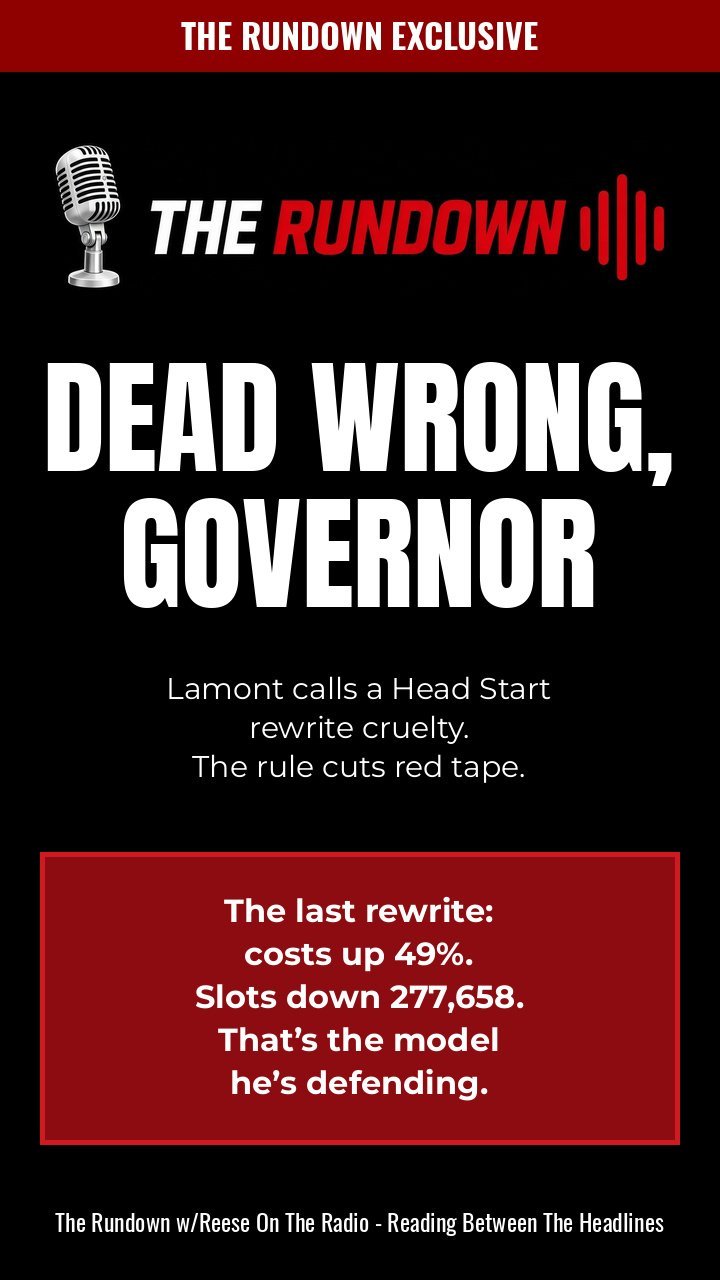
Dead Wrong, Governor
Lamont calls a Head Start rewrite cruelty. The rule cuts red tape.


Ned Lamont stood in a New Haven Head Start office on Tuesday, high-fived a few toddlers, and told the cameras the Trump administration is about to make life "a lot more burdensome, bureaucratic, expensive and impossible" for working families. CT Mirror, under the byline of Maia Nehme, headlined the governor's verdict. The headline that ran Wednesday in the Hartford Business Journal reprint: "Dead wrong: Lamont says changes to Head Start would make life harder for families."
Read that again. The federal proposal is a deregulation. Lamont called deregulation more bureaucratic. The story treated that line as the news.
Here is what the proposal actually does, per the piece and the federal notice itself, once you get past the parent anecdote. Health and Human Services wants to scrap a stack of federal Head Start performance rules. Larger class sizes would be allowed. Degree requirements for many staff would no longer be dictated from Washington. Disability rules would sit on a looser federal floor. Unhoused families would have to document their homelessness instead of just attesting to it. Classroom instruction would be in English, with tribal language programs exempt and a waiver process subject to HHS approval. The administrative overhead cap would drop from 15 percent to 5 percent. HHS says the package could save about $2.2 billion and support as many as 236,000 additional slots nationwide. Connecticut served 4,847 children and 46 pregnant women in Head Start in 2024-25. That is the whole program in this state. The national slot estimate is not a rounding error.
The story does not lead with any of that. It leads with Charles Walters, a dad whose daughter's motor skills "jumped exponentially" at LULAC Head Start. Nice family. Irrelevant to whether Washington should keep writing the employee handbook for 1,600 Head Start grantees running thousands of centers. Then the verb. Officials and providers "gathered Tuesday to lambast" the overhaul. Lambast is not a reporting word. It is a cheer. By the time you reach the governor, the frame is already set: cruelty, not a rulemaking.
Lamont's quote is the tell. "They're making life a lot more burdensome, bureaucratic, expensive and impossible for our working families. I think it's dead wrong." The agency he is attacking said, in the same story, that the rule "removes duplicative regulations and red tape that have driven up the cost of the program, decreased slots, and failed to improve outcomes for children." Programs that like the old standards can keep them. The HHS spokesperson put it plainly: some elected leaders "do not trust Head Start directors, teachers, and parents to make wise decisions" and would rather have Washington tell every center exactly how to run. That sentence is in the article. It is not the headline. It is not the close. It is an emailed rebuttal parked between the ads.
The omission that matters is the record on the last big standards rewrite. An HHS analysis of the 2016 Head Start rule, published in August and back in the news this week, found the trade the regulators promised never showed up. They expected preschool costs to hold near $10,575 per slot. By fiscal 2024 it was $15,752, up 49 percent after inflation. They forecast 123,614 lost slots over ten years. Slots fell by 277,658 from 2015 to 2025, more than the 2016 rule and a 2024 follow-up rule forecast combined. Classroom quality scores barely moved. That is the bureaucratic model Lamont is defending. CT Mirror did not mention it. Neither did the press-conference copy.
English instruction gets the same treatment. The story says the rule "would mandate that education programs be taught in English," full stop. It does not say Head Start is a school-readiness program aimed at kindergarten classrooms that teach in English. It does not say programs can apply for waivers. It does not say tribal language programs are exempt. It pairs the English line with "require unhoused families to provide documentation of their homelessness," as if requiring paperwork is the same thing as throwing a child out. Documentation is how you stop a benefit from becoming a rumor. The piece never asks who currently gets a slot without it, or what that costs the family that did the paperwork.
"Some researchers," unnamed, are cited for the claim that state and local childcare standards are "less stringent." That is the whole sourcing on quality. No study named. No Connecticut comparison. No parent who wants a local director instead of a federal manual. Attorney General William Tong and Commissioner Elena Trueworthy get the condemnation lane. The other side gets a spokesperson email.
Then Lamont pivots to the state's own checkbook. The Early Childhood Education Endowment, more than $700 million, is supposed to make childcare free for eligible families earning up to $100,000 starting in July 2027, and cap the parent share at 7 percent above that. "But I'm not letting the federal government off by saying we'll just make up all the shortfall," he said. Shortfall of what? The federal notice is a rule change, not a canceled appropriation. The governor is pre-writing the invoice.
This is the pattern. A contested program with a long argument about fade-out and cost gets covered as settled science the moment a Democrat holds a presser in a classroom. The headline is the politician's insult. The body is the politician's allies. The counter-facts that would complicate the insult sit in a federal analysis that has been public since August, and the story never mentions it.
Connecticut families are not asking Hartford to perform outrage about class-size manuals in Washington. They are asking why the heating-oil tank and the childcare slot got more expensive, and why the electric bill is still a burden, while the people in charge congratulated themselves on standards. Heating oil in this state is up more than 80 percent from a year ago. Electric rates are still well above the national average even after an election-year credit paid for partly with bonding. If a rule can put more kids in a seat by spending less on paperwork, that is not "dead wrong." That is the job. Calling it impossible is the tell that the standard being protected is the one that keeps the press conference going.
Get The Rundown
Columns that read between the headlines, plus the full show weekdays 2–6 PM ET on WTIC NewsTalk 1080.